
1. Introduction
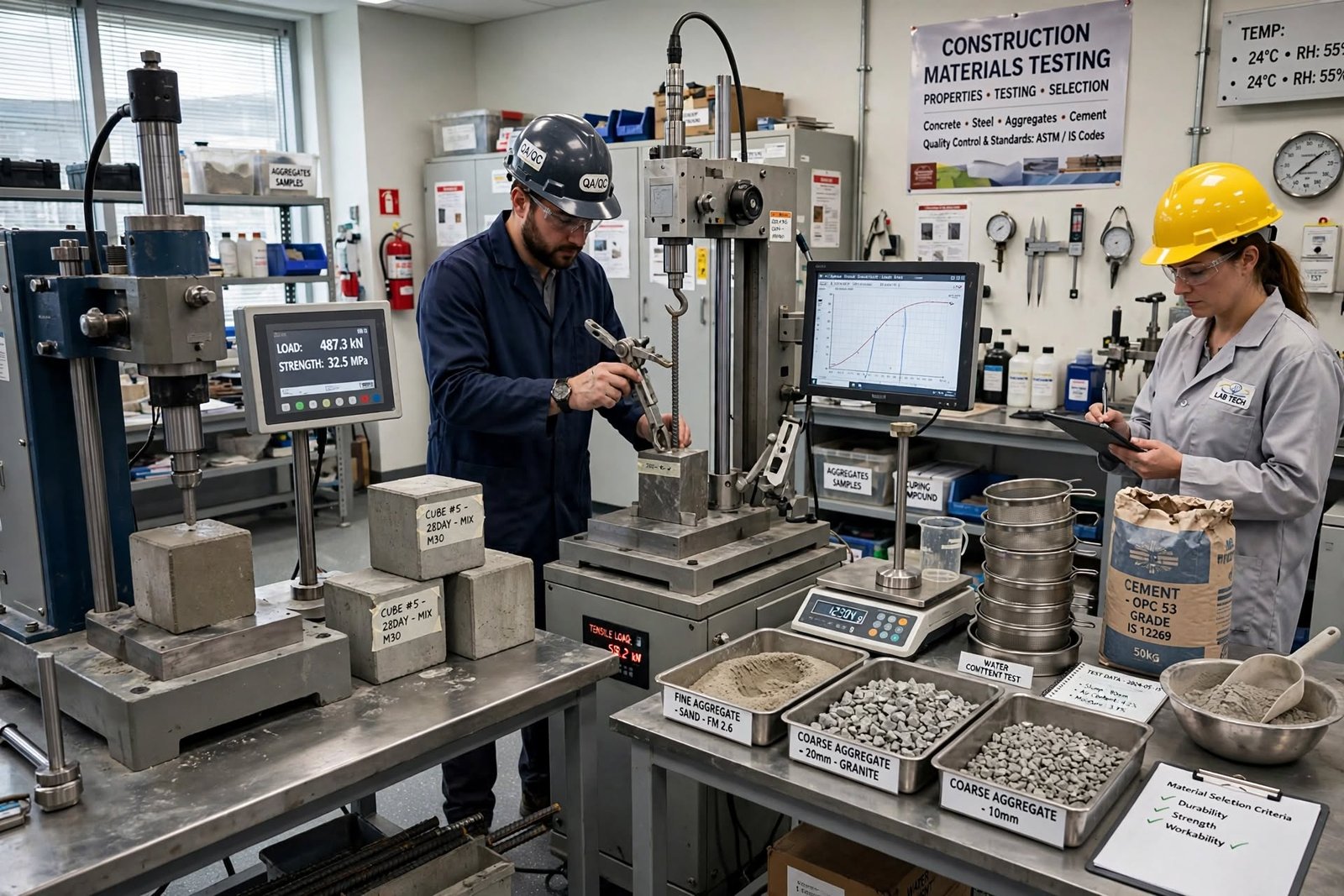
Construction materials are the foundation of every structure. The quality, properties, and correct selection of materials directly determine the strength, durability, and performance of a building. Poor-quality materials or incorrect selection can lead to structural failure, premature deterioration, and safety hazards.
This comprehensive guide covers the key construction materials used in Indian construction — their properties, testing methods, and selection criteria. Whether you are a client, contractor, or engineer, understanding construction materials is essential for successful project delivery.
2. Cement — Types and Selection
Cement is the binding material in concrete and mortar. In India, the following types are commonly used:
2.1 Ordinary Portland Cement (OPC)
Available in grades 33, 43, and 53. Grade 53 is used for high-strength concrete; grade 33 is used for general construction.
2.2 Portland Pozzolana Cement (PPC)
Contains fly ash or volcanic ash. Offers better durability, workability, and resistance to sulfate attack. Ideal for mass concrete and marine structures.
2.3 Portland Slag Cement (PSC)
Contains blast furnace slag. Offers excellent resistance to chloride and sulfate attack. Suitable for marine and industrial environments.
2.4 Rapid Hardening Cement
Develops strength quickly — used in precast concrete and road repairs.
2.5 Low Heat Cement
Generates less heat during hydration — used in mass concrete like dams.
Selection Tip: Always check the cement's manufacturing date. Cement loses strength over time — as a rule, cement older than 3 months should be re-tested before use.
3. Aggregates — Properties and Testing
Aggregates form 60–75% of concrete volume and significantly influence its properties. They are classified into fine aggregates (sand) and coarse aggregates (gravel or crushed stone).
3.1 Key Properties
- Grading: Distribution of particle sizes — affects workability and strength.
- Shape and Texture: Angular particles offer better bond; rounded particles improve workability.
- Specific Gravity: Determines concrete density — typically 2.6–2.8 for normal aggregates.
- Water Absorption: Affects water-cement ratio and durability.
- Soundness: Resistance to weathering and volume changes.
3.2 Standard Tests
- Sieve analysis (IS 2386 Part 1)
- Specific gravity and water absorption (IS 2386 Part 3)
- Aggregate crushing value
- Aggregate impact value
- Los Angeles abrasion test
- Soundness test
4. Concrete — Mix Design and Quality
Concrete is the most widely used construction material. Quality concrete depends on:
4.1 Mix Design
Determining the right proportions of cement, water, fine aggregate, and coarse aggregate to achieve the desired strength and durability. IS 10262 provides guidelines for concrete mix design.
4.2 Grades of Concrete
- M10, M15: Lean concrete for leveling and foundations
- M20: Standard for residential construction
- M25, M30: For high-rise buildings and heavy structures
- M35 and above: For bridges, industrial, and marine structures
4.3 Quality Control
- Slump test for workability
- Compaction factor test
- Cube testing for compressive strength (7-day and 28-day)
- Non-destructive testing (rebound hammer, UPV)
5. Steel Reinforcement
Steel reinforcement provides tensile strength to concrete. Common types in India:
5.1 Types of Steel
- Fe415: Yield strength 415 MPa
- Fe500: Yield strength 500 MPa
- Fe500D: Higher ductility — recommended for seismic zones
- Fe550: High strength for heavily loaded members
- Fe600: Very high strength for special applications
5.2 Testing
- Tensile test (yield strength, ultimate strength, elongation)
- Bend and rebend test
- Chemical composition analysis
5.3 Storage and Handling
- Store steel on wooden planks — never directly on ground
- Protect from moisture to prevent corrosion
- Use clean, oil-free steel for best bond with concrete
6. Bricks and Blocks
Bricks and blocks are used for walls and partitions. Common types:
6.1 Clay Bricks
- First Class: Table moulded, burned in kilns — for exposed work
- Second Class: Ground moulded — for internal walls
- Third Class: For temporary structures
6.2 Fly Ash Bricks
Environmentally friendly, uniform size, lighter in weight, better thermal insulation. Growing popularity in Indian construction.
6.3 Concrete Blocks
- Solid Blocks: For load-bearing walls
- Hollow Blocks: For non-load-bearing walls — lighter, faster to build
- AAC Blocks: Autoclaved Aerated Concrete — lightweight, thermal insulation, fire resistant
6.4 Testing
- Compressive strength
- Water absorption
- Efflorescence
- Dimensional tolerance
7. Material Testing and Quality Control
Quality control ensures that materials meet specifications. Key aspects include:
- Sampling: Random sampling from each batch or consignment
- Testing: Conducting standard tests per IS codes
- Documentation: Maintaining test reports and traceability records
- Approval: Rejecting non-compliant materials
- Third-Party Testing: Independent lab verification for critical items
8. Common Material-Related Failures
- Poor Quality Cement: Leads to low-strength concrete and early deterioration
- Wrong Aggregate Grading: Reduces workability and strength
- Excessive Water: Reduces strength, increases shrinkage and cracking
- Under-Reinforced Concrete: Results in premature structural failure
- Corroded Steel: Reduces tensile capacity and causes concrete spalling
- Substandard Bricks: Weak walls, water seepage, poor appearance
- Inadequate Curing: Prevents full strength development
9. Conclusion
Construction materials determine the quality, durability, and safety of every structure. Careful material selection, rigorous testing, and disciplined quality control are essential for successful projects.
At Construction Aid, we bring over 40 years of experience in material testing, quality control, and construction supervision. Our team ensures that every project uses the right materials, meets standards, and delivers long-lasting value.
Need Material Testing or Selection Advice?
Get expert guidance on materials, testing, and quality control from an experienced civil engineer.
Schedule a Consultation